Showing posts with label ASD (Autism Spectrum Disorders). Show all posts

Tuesday, April 02, 2013

A perfect piece in His hand

"On a nationwide level, the Puzzle Piece symbol reflects the mystery and complexity of Autism Spectrum Disorder (ASD). Also, since every puzzle piece is different in some way, a puzzle piece accurately represents the diversity of the individuals affected. " - Autism UGA blog 

Today is Autism Awareness day. In June 2010, I was diagnosed with PPD-NOS mainly because no one knows why I didn't speak until age two. Was it because of my sparsely enriched environment in the Philippines or would I have had a speech delay even if I was born in the US and in a typical childhood environment? Had I not had the speech delay, I would have been diagnosed with Asperger Syndrome. 

Autism Awareness month is meaningful to me because I worked in a group home where almost all the clients were on the autism spectrum. I did my best to help them using the training I had as well as personal experience. For example, I knew when one was too upset to use his words, so I would say, "I know you're too frustrated to talk, so could I just see a sign." When he would sign what he wanted, then we were able to move on. 

Today I was thinking about the significance of using a puzzle piece to represent autism. As the quote states, it's to represent the mystery and complexity of the disorder. For me, it also represents a piece that was missing for so long. I didn't know why I had these special interests and why I couldn't hold a conversation like other children. I didn't know why sudden loud sounds bothered me. I didn't know why I could learn about human development but yet have trouble interacting with my adult peers. The diagnosis of an autism spectrum disorder (ASD) was the final piece to my identity I was missing. 

When someone is handed a puzzle piece, it's meant to be put somewhere. Perhaps this also represents autism awareness: How best do we integrate those with autism spectrum disorders into society? I would suggest what Dr. Grandin would say: Place us in work environments that use our strengths. For example, I don't mind researching case-law and statutes, and I could do that to write a legal brief. Could I give a speech in front of the Colorado Supreme Court for half an hour? Probably not. Could I write the brief the attorney would use in her arguments. Perhaps after a few years :) Kanner, who researched autism last century found that an individual who enjoyed math and numbers became an accountant. And of course, there's Dr. Grandin herself who owns her own Livestock Handling business and is an avid researcher at Colorado State University. Her love of animals and fascination with animal behavior has made her one of the most epic scientists ever!!! 

When I see myself as a puzzle-piece, I do not think of it negatively. I see myself as a piece in God's hand. He has crafted me into His exact shape, and He has a place for me. He has placed me as an employee at a group home, as a teacher in Children's Ministry at Summitview, as a volunteer at Colorado Legal Services, as a research assistant at Colorado State University, and more recently, as a unique part of my Boaz's heart :D 

More importantly, God has placed me in His larger plan to show Himself to the world as Savior and God. He is using my life in this way. How, I don't know yet. However, Romans 8 says that God uses ALL THINGS for the good of those who love Him. He uses  people going about their normal lives, missionaries, pastors, parents, and little puzzle pieces like me to show that in Christ, we have hope that overcomes our obstacles. I am not a mystery to God, and He knows exactly where to place me in His plan. I am a perfect piece in His hand. 


Saturday, March 30, 2013

Mentor

I just got home from a day at the zoo with Boaz and his son Bobby*. Boaz has Bobby for Spring Break before he goes back to Pennsylvania. Boaz sees Bobby over the summers and school breaks. This is the same boy who may get tested for Asperger Syndrome later. 

*Name changed for purposes of this blog.

As I was preparing to meet Bobby, I did some research on how people come into the role of step-parent. This might become a reality in my life if/when Boaz and I get married. I asked God what He would want for me as a step-parent of a kid with Asperger Syndrome. I knew from my HDFS classes that I wold come alongside Boaz and continue to allow him be the primary parent as far as rule-setting and such. 

One thought that kept coming to me was one word: Mentor 
Image from Google Images
I could be a mentor to Bobby as a) someone who loves Boaz and wants to support him in his parenting and b) as a significant adult in Bobby's life who also happens to have an Autism Spectrum Disorder (ASD). I know somewhat about where Bobby is coming from. Of course, I need to know him as a person first, and that will come over time. But even today, I would notice that he really liked this gravel pit with large pebbles. I said, "That feels really cool on your hands, huh?" Because I knew it was a sensory thing. I also asked him, "You can't stop thinking about those chair-lifts, can you?" Because he had a pretty strong one-track mind about that until Boaz took him and I on the chair-lifts over the zoo. 

Bobby let me hold his hand to get off of the chair-lift and let me help him with his ice-cream. He asked Boaz if I was going to be around tomorrow, and Boaz explained that I would be celebrating Easter with my family and they would celebrate with theirs. 

Tonight, I was hit with the reality that God had been preparing my heart to be this eight year old boy's mentor for a long time. I was a nanny to some kids for two summers a while back and I've learned how to bond with kids that were not biologically or legally mine. Finally, I've had a longing to be an example to others on the Autism Spectrum ever since I got my diagnosis and went to two of Temple Grandin's lectures. 

God works in mysterious but awesome ways. I continue to pray that as I grow closer to Boaz and Bobby, that God would continue preparing my heart for the most important mentoring job I will probably have: Helping the man I love parent and show Christ to his son, and show this boy that God allows us to triumph over challenges He has allowed in our lives. 

Wednesday, February 13, 2013

Just a little bit of history repeating

I know of an elementary school aged boy who has recently had a diagnosis of an attention deficit disorder (ADD or ADHD), but one of his caregivers believes he has something on the autism spectrum. When I heard of his tentative diagnosis, I thought about how I wasn't diagnosed with my autism spectrum disorder (ASD) until age 27, and I felt sad that this little guy might travel down the same path. 

Right now he stands at a crossroads if he indeed has an autism spectrum disorder. 

His educators and other caregivers could evaluate how he does with  interventions geared toward individuals with attention deficits, see if he still needs to be evaluated for other learning disabilities, and refer him to a specialist to test him for ASD. If he indeed has an ASD, he could then receive interventions for that and learn how to adapt to his world. He could have a better quality of life than I did at his age because he would have caregivers and teachers that understood the workings of his brain and use that understanding to him thrive in the world. 

On the other hand, he could get the attention deficit diagnosis, but the intervention might not work because the ASD was missed. He could go through school wondering why he isn't achieving to the level that his intelligence would indicate. He could spend much of his life wondering what he was doing wrong and why he isn't able to act normal. A mentor could help him develop his talents, but he might not get the help he needs if his ASD isn't recognized. This path is harder and he would be more vulnerable to emotional wounds inflicted by caregivers, peers, and teachers that don't understand him. He could self inflict his wounds by constantly telling himself that he is not good enough, he can 'never get it together,' and that he should know better every time he runs into a social mishap. I have walked this path, and I pray desperately that he will not have to. 

However, I do not think he will not walk my same path. Teachers are more aware of Asperger Syndrome and high functioning autism and may pick up that he has it sooner or later. If he indeed has an ASD, hopefully it will be picked up before he enters college. More importantly, this boy has a loving father that loves God. Even though he lives across the country from this child, this father  shares God's love and hope with this child every chance he gets. This boy has heard God's truth and has people praying for him that he doesn't even know. If this child sees God as real in his life and knows God is the one who made him and knows that God is the Creator who made him just the way he is, this boy will not go down my path. This boy's path may still be challenging. However, because of God's grace, this boy's path may be filled with hope. 

Friday, April 20, 2012

A little brother!!!!!!!!!!!!!!!!!!!!!!!!!!

At work I have a little brother!!!!!!!!!!!!!! I'll explain: There's this kid who's an aspiring computer science major who works at Corbett with me. We talk during lunch before our shifts, but today we worked at adjoining stations. I served sandwiches and he served gluten-free food :)

At some point we were talking about something or other and I mentioned that I was diagnosed on the autism spectrum as well. He had talked openly about being on the spectrum. It was like we suddenly became brother and sister - sorta - I don't know exactly what that feels like, but it's like we could relate on a whole new level. It's like someone saying, "You know, I grew up in France, and now I live here in England." and suddenly you're like, "OH MY GOSH, I GREW UP IN FRANCE TOO!!!" "Did you have to adjust to THIS... and THIS????" "UHHUH!!!!!!!!!!!!!!!!!!!!!!!!!!!!!"

So in between serving customers we totally nerded out about stuff like things Dr. Grandin says and stuff about our own lives. I still think of him first as a computer science major, and secondly as my brother on the spectrum. Just like I think of myself as pre-paralegal and then on the spectrum.

But it's nice to have that connection :) Just to know there's someone that I can actually talk to without feeling intimidated (read: someone else besides Dr. Grandin) who knows what I'm going through :)

I also want to keep in touch with him. Maybe tell him what college is like and advice on what I know now that I wish I knew my Freshman year. It would be kind of cool to be his mentor of sorts. :)

I also realized this: If God gave me a little brother on the spectrum, than He could give me a HUSBAND on the spectrum or a neurotypical husband who maybe not experience what being on the spectrum is like but is understanding of all of it to live with me hehehe!!! That thought also made me smile :)

Friday, April 13, 2012

When a Desire Resurfaces

I'm in the house of Summitview nerdlings (children of parents who are both enginerds) watching them for an evening.  We ended the evening of Lego robot demonstrations and Star Wars Wii with a Bible study.  I won't lie,  it felt weird teaching a passage to kids outside of a classroom setting and in a different age group than what I'm used to. 


But when I was done,  I felt an odd feeling: the desire to be a Christian parent.  Yup.  You read right!! The spectrumite who until recently assumed she would neeeeeever marry because a certain famous spectrumite never did is rethinking all that.

Here are my feelings on all this:

Why do I want to get married all of a sudden?  Because what if God really DOES have an earthly man who gets me enough to want to tie the knot?  It would make me happy.  The adjustment would take getting used to, but I would be less scared knowing said guy would be there to help too!  Plus nerdlings are so cute!!!!  God, if I with copious COPIOUS amounts of Your help raise a future scientist, doctor,  or professor who wants to reach academia for Jesus, that would be SOOOOOO COOOOOOL!  And even if I pop out super-nerdlings (spectrumites) I'd understand them and they'd understand me and that would be cool!!!! 
I still want a career and I'm not ready to rely fully on a guy to support myself + progeny.  I like the idea of me relying on myself (somewhat since God ultimately provides) putting money in the bank.  I also like the single life: roommate dinners, eating ice cream for dinner and leftovers for breakfast (sometimes). But I am opening up again to see that I still think it would be cool to raise the next generation of. Christians. Not as the ultimate HDFS badge of "you made it!!!!!!" But if that is how God wants to show His power through limited people :):)

Monday, October 17, 2011

A for Autism and awesomeness aka Temple Grandin

So this is a continuation of my previous post :)


When I first was told that I might have autism I freaked out really badly. That was understandable since getting a diagnosis of a disability is hard for anyone. But I truly felt like my future was over and that I would never be successful or achieve anything because I like most other people thought of low-functioning autism when I heard the term.


This picture was taken by the Fort Collins Coloradoan when they covered the celebration where the Temple Grandin Scholarship was unveiled. I was actually at the celebration and ACTUALY GOT TO SHAKE DR. GRANDIN'S HAND!!!!!!!!!!!!!!!! :) :) :) erm... I digress...

That celebration reminded me of how Dr. Grandin changed the way I thought about autism - about my diagnosis of an autism spectrum disorder. I know I've said this a million times on this blog, but it was her story that turned my thinking around from, "AAAH! I'm on the autism spectrum, this means I'll NEVER SUCCEED AT LIFE and I'm somehow lesser." to "Hm... maybe I'll become a famous researcher now that I know I'm way way way more nerdy than the average person." It made me smile a little.

\More importantly, when I think of autism now, I don't think of a child in a corner locked in his or her own world. I think of Dr. Temple Grandin lecturing, or being licked all over her face by cattle, or teaching a class. I think of the way she's honest about her continued need to adapt to sensory issues and how she's continuing to learn about the social world. I think of how far she's come with the right help from teachers, her aunt, and her mother. When I think of autism, I think of her and I think of how I can help my clients engage with the world and adapt just like she has. 


The scary A-Word!

This article here states that infants with low birth weight are at more of an increased risk for autism. The lay-press article is based off of J.A. Pinto-Martin et. al. (2011) Prevalence of Autism Spectrum Disorder in Adolescents Born Weighing <2000 Grams. Pediatrics, 128(5), 882-892. 

It's interesting because I think a lot of people freak out when they read a risk-factor related to autism. It's like the dreaded developmental disorder diagnosis.  Because people often think of kids and adults with the disorder as mute and having severe behavioral issues. They might think about the bad things like uncontrollable temper tantrums that the caregiver can't contain unless he or she figures out the sensory issues or frustration issues behind them. They might think of the things like the child or client not being able to reciprocate affection.

As a caregiver in a group home, I can appreciate how hard it is to deal with the behavioral issues. I have thought many times, "Hm. I wonder what it would be like to get into Client A's head." I can imagine that it would be difficult for someone to raise a child or care for a client long term and have much of that client or child's inner workings of his or her brain be a mystery. I could also understand that the reciprocal affection is not always there. For example, when I say good bye to a certain client, he will sometimes give me a wave, but other times he is off in his own world and will give me a slight glance as I wave to him to leave. On the rare occasion, his wave is paired with a smile. That makes me feel warm inside.

Even if I wasn't on the autism spectrum, I would hope I would have a better outlook when I hear the word autism. I think of when I watched Wizard of Oz with another client for whom tornados and witches are some of his special interests. The big grin he got on his face when I said, "Look, S! It's the tornado! IT'S GETTING THE WITCH!" and he laughed is an image that comes to mind when I hear autism. And the interested look and small smile another client gave me once when I turned on a string of decorative lights in the living room is another good image. Even if I never experienced autism myself, seeing people on the spectrum  enjoying their environments as well as when they struggle in their environment might give me a more balanced picture of autism. If I become an occupational therapist, I hope I can pass that along to others as well.


Tuesday, September 20, 2011

Seeing another's path and finding my own

I'm taking a class called Handicapped Individuals in Society  (OT 355) as part of preparing to apply to CSU's Occupational Therapy  program. Sometimes it makes me remember or think about how I've dealt with my disabilities in the past and how I'm doing now. 


According to the reading I read yesterday, people who are in the bargaining mindset (from Kubler-Ross's grief process model) see a glimmer of hope and seek out how their disability can be fixed. 


I realized that was partially to account for my fixation on Dr. Temple Grandin. Soon after my diagnosis of PPD-NOS, I was searching for a future. I was wondering, "Now what?" Conveniently enough, someone had lived life with an autism spectrum disorder and she was just a bus-ride to campus away. 


I became fixated on her life because I needed a path to walk down. My whole sense of who I was and my future was rearranged, and I needed somewhere to go. 


I thought, "If my life could look like hers, I will be ok." "If I do what she does, then I think all this will be worth it." That was why it was the bargaining phase of my thinking. That clamoring to find something to not necessarily fix, but finding something good to balance out the really intense bad feelings of, "Oh my goodness, someone threw a sledgehammer at my development / identity / future plans!!!!!!!!!"


Well,  EXACTLY A YEAR AGO, I actually got to see Dr. Grandin at a lecture!!!!!!!!!!!!!!!!!!!!!!!!!!!!!!!!!!!!!!!!!!!!!!!!!!!!!!!!!!!!!!!!!!!!!!!!!!!!!!!!!!!!!!!!!!!!!!!!!!!!!!!!!!!!!!!!!!!!!!!!!!!!!!!!!!!  Yes, she gave that exact lecture, though this picture wasn't taken at Colorado State University. It was pulled from Google Images. Anyhoo... I saw her at the University Center for the Arts at Griffin Concert Hall with one of my best friends Kristina.... IT WAS REALLY AWESOME AND I TOTALLY EEKED AFTERWARD!!!!!!!!!!!!! 

Erm - sorry, I got distracted :) So after the lecture, I realized that I can't follow exactly in her footsteps a) because livestock is not my thing (I'd so get trampled, and cows and horses smell funny) and b) more importantly, our ASD affects us in different ways. Dr. Grandin is totally cool with giving a lecture in front of millions of people since that's apparently what she spends half her life doing. She's less comfortable just hanging out talking with people even though she does it during book signings. I don't know how much she'd like working at the group home where I work. I like it :) 

So I realized this: Our paths initially cross wherein we both are on the autism spectrum, and we are both affiliated with CSU, but we're very different. Part of moving into an acceptance frame of mind was when I realized that I could look at her path to see how God used one person's disability and then trust Him for how He would use mine. One way where Dr. Grandin and I are the same, is that I've had the opportunity to help my clients on the spectrum and empathize with them because I've felt similar frustrations as they have.  Where my path will go, I don't know. It might cross Dr. Grandin's path again, or it may go a completely different way, and that's fine :) 


Saturday, August 27, 2011

When the feeling is (neurochemically) stripped away

Something I didn't mention on the vacation summary was that I did all that on 2x my normal dose of antidepressants that I take in very low doses for anxiety that comes with having an autism spectrum disorder. I decided ahead of time to up my dose (which my doctor said it was ok to do in times of stress) because I knew I'd be a formal caregiver for my mom, and to a lesser extent, my grandma and my aunt. It was hard being "lead staff" at the airport at DIA. I felt sensory overload coming on, and if I had aggressive tendencies, I probably would've thrown something. I was grateful that I was potentially 'overcompensating' by having more calming neurotransmitters in my brain for crisis situations that did actually come up. 

I went back to my normal dose after vacation, but I still felt emotionally 'blah.' it's like someone still hadn't turned back on half of my emotional connections that were somewhat suppressed on vacation. The basic emotions like happiness, sadness, fear, and anger I could still feel, but I didn't have access to more complicated or in depth emotions. 

This affected my relationship with God, along with not really being able to completely focus on reading the Bible and/or praying over vacation. I didn't feel motivated to pray or long for a connection with God. 

Yet I knew logically that connecting with God is good. God calls us to remain connected like a branch to the rest of the vine (John 15:5), and as I am one of His creation, and one of His redeemed, it's nice for me to check in :) I knew God's Word is spiritual nutrition, and depriving myself of that is like not physically feeding myself. 

During the time when I was going back to my normal dose and letting my brain 'reset' itself, I still felt like I was in an emotional dry spell. People would tell me things and I could logically empathize with them and feel sad or happy when they told me something, but I couldn't quite completely feel the complicated emotions they were feeling. I realized this during a meeting with some other people from Symbio. It felt good to tell people that I was in an emotional dry spell and needed my Creator's help to  connect to Him even if only the intellectual channel was open and also it would be nice if He helped my brain :D 

Well, good news, I think my brain has finally reset itself!!!!!!!!!!! I feel excited about a friend's bridal shower, and a greater depth of joy as I read the Bible and listened to some worship music. One thing that I think helped me connect to God was just to listen to truth (getting a Chris Tomlin CD from the library helped :D ) and just soak my brain in it. I just pondered it and reminded myself that it was logically consistent. Chris Tomlin's And if Our God is For Us CD has a lot of great theology packed into its songs! 

When many of my more complicated and deep emotions appeared neurochemically stripped away,  my belief in God was retained. My connection with God was retained of course through His Spirit and also because I have learned too much about God to just deny Him. I know He holds all things together and is the strength of the believer. I know He rebuilds and redeems and nothing can stop the rebuilding process for a people or for an individual (look at the books of Nehemiah and Ezra). I know He is sovereign, and He works all things for the good of those who love Him. He is Savior because Christ ressurected from the dead defeating death and sin. I felt happy being reminded of these truths and being reminded that they are logical and conceptually tied together in a lot of ways. Now that more emotion circuits are turned back on, I can feel a deeper joy and my love can grow more and more in knowledge and depth of insight (Philippians 1:9). I am glad that my growth is ultimately up to God and not dependent on my own emotions and neurochemistry!!!!!

Thursday, August 11, 2011

Leaving ... on a jet plane!!!!!

Right.  Cliche title,  but yeah!  I'm going on vacation - ok to a family reunion.  Dang,  getting four people to the gate : one with osteoporosis,  one with Down Syndrome,  one with anxiety / depression,  and one spectrumite is honestly and truly an act of God. If I wasn't related to Mom I probably would have smacked her when she kept on asking if I still had all our boarding passes.
I could feel myself hitting sensory overload in the coffee shop.  So many people and me keeping track of everyone and the coffee machines grinding.  I had to stop and think, covering my face for a moment.  But we're all here now.


In these moments I can choose to get bitter that I have to deal with anxious family members as well as deal with my own sensory issues, or I can cope. I cope. Pray,  and I did sort of pretend I morphed into Super-Nerd since she frequents DIA en route to lecturing everywhere. But yeah.  I'm glad God plus a double dose of my meds is getting me through the morning!!! 

Monday, May 09, 2011

An Explosion of our Thoughts

I have more empathy for Dr. Grandin's co-authors and other staff than I did this morning. Today I typed up some notes from one of her lectures to give to a teacher who works with a vocational training program in a high school here in Fort Collins. 


I didn't realize how much she jumped around in her lecture - even though she had a slide show - until I started organizing her points into main categories. Oh man... It wasn't impossible, but I did have to work on it. 


Seeing her thought process through my notes made me smile. Though I am not a purely visual thinker like she is, I had problems organizing my thoughts. I would write essays that had good content, but the organization was terrible. Getting yelled at to make sense only made trying to organize my thoughts even harder. I would get scared that what I was saying or writing didn't make sense, and the impossibleness of the task was affirmed if I was yelled at. 


Over time I learned how to write an outline and I saw how others organized their thoughts through reading books. Noting how authors described things and transitioned scenes or ideas gave me a template on how to organize my thoughts. I progressed in my writing as I went through school with the help of teachers who helped me in this area as well as encouraged me to express my ideas in writing. 


Now to tie this in to Dr. Grandin's writing: I only know her through books and lectures. I see the progression in her writing as she has improved in organizing her thoughts. I am grateful that she never got yelled at (as far as I know) for not organizing something perfectly and she had tremendous support from her staff and other writers as she began her writing career. Her brain is an explosion of thoughts - of amazing images. She has others help her piece together into a coherent whole she can present to the world. 


I have had that support through my latter years of high school and throughout my years at CSU. My mind can still be an explosion of thoughts, but I am learning how to put them into a coherent whole as well. Through this process, I hope to share what God has done with my life to reveal the hope He has to offer to individuals in a broken world. 

Sunday, May 08, 2011

Truth, Logic, and my Emotional Connection to God

I have always had a physical reaction to music. Mom has stories of how I could clap in time to the music on Sesame Street and how I would move my body to music when I played the piano. Therefore, it was easy to take that reaction and be able to worship with my whole being. People always comment at how I'm always moving during the music part of church.

However, the emotional connection with God came gradually. Even during The Rock, I danced around and stuff mostly to blend in at the beginning. When people got really passionate and emotional during prayer, I didn't get it at first. It might seem odd to people who know me now, but it's a process.

Here is the process:


Much of my early Christian development was focused on learning about God. I first had to learn about God as Creator. This is the most tangible example of how my emotion process to worship worked, so I'll use this as an example. I first had to learn that He was Creator. This meant that I had to learn about why evolutionary theory didn't work and why the idea of an intelligent designer made sense. This was logic.

The next thing that happened was experience. As I went through my biology classes, I saw the complexity of the cell and organ systems in the human body, I realized that an intelligent agent was behind it. This reinforced the logic. I could see and experience it.

Once I was convinced logically and experientially that God was Creator, I felt happy. Someone made me. Therefore someone cares for me. I am not alone. Someone made this world and made it to make sense, therefore, curiosity about the world glorifies Him!!!!!! That excited me because I enjoyed learning about His world anyway :) Then the happiness and 'eeks' flowed out!!!!! When we at The Rock first sang a song that I recognized as a song to our Creator, I went up front. I was a little nervous because I knew it was going to be loud, but I just felt like I had to jump around and praise God as Creator because I finally realized He was Creator and He showed me - He graciously showed me even though I denied it to His face for so long.

I believe God had to teach me physical foundational truths of His presence and how He addresses the larger problem of evil and sin before He began teaching me more about how to have a relationship with Him. Getting concepts about Him as Creator and learning apologetic tools to explain His existence to others tapped into my intellectual side. I got excited about those things first.

However, having a relationship with a largely abstract Person was different. I would see my friends cry at a prayer meeting because they "were feeling their hearts drawn toward Jesus" or longing for Him. I could understand crying for a friend in a biology class that needed to know Jesus because I could see the inconsistency of studying God's intricate creation of the cell and not acknowledging Him for it.

I only really started to get it after my sophomore year of college when I realized that The Lord's prayer started out: Our Father. Somehow God was a parent to us. Back to logic. As I saw in the Bible of how God cares for us, guides us, has rules for us, comforts us, gives us strength and encouragement, I realized those are all things that competent parents do for their children. Trust formed out of that and I would ask Him for simple things. Seeing tangible answers to prayer like having little circumstances work out built that trust and thus reinforced my praying. After trust and that experience that was built on logic finally allowed me to feel God's love.

Why do I draw out this diagram and explain things the way I do to break down my thought processes around my emotional connection to God? Because Dr. Grandin says that she doesn't feel the same awe toward God or scenery He's made like other people due to her autism. That made me wonder for a long time if a lot of my reactions were contrived in an attempt to be neurotypical - especially before I knew I was on the autism spectrum.

Yet I know I have an attachment relationship with God. Recently I read an article about adults with high-functioning autism / Aspergers Syndrome / PPD-NOS who completed the Adult Attachment Interview. They were able to be classified in the usual way and came out with a variety of attachment patterns. Therefore people with autism can form connections to people. Dr. Grandin talks about her mother and Mr. Carlock a lot and I can see from her history that she trusted them growing up and saw them as attachment figures. Therefore logically, I know it is possible for me to have an attachment relationship of some sort with God as He is indeed a personal God. An all-knowing Creator who wants to connect with me will do it taking into consideration on how specifically my ASD affects me because He knows how it does. He knows exactly how my DNA is sequenced and how that affected my brain. That just makes logical sense. I came back to that when I was asking myself if my emotional connection was real.

I realized that I needed more of a logical / intellectual base to have that initial emotional reaction, but once I did and my intellect was convinced of the truths about who God is, the emotion I feel toward Him is indeed real.

Monday, April 18, 2011

Nerdy Geeky Brains!!!!

So both my grad school friend,  former advisor,  and I have no idea what's going on for our meeting in an hour!!!  I blame our specialized and under-connected nerdy geeky brains!!! According to different studies and images of Temple Grandin's brain,  there are less connections between parts of the brain in autism and some specialty areas get very developed. 


My former advisor and my friend are definitely NOT on the autism spectrum, but if nerdy / geeky normal people have some traits that are still within normal limits,  that means their brains might have some mix of over and under connectivity that allows the geeky nerdy traits to happen. This includes being able to code interactions, but forgetting about meetings and such ;)  There's a reason for the "absent-minded professor" jokes :) 


Dr. Grandin and I have more extreme versions and variations of that. This is why we're on the autism spectrum.  But it's nice to know even certain normal brains resemble ours!!!!  Maybe that's why nerdy geeky people keep coming back to or staying in academia!!  Similar brains think alike!!!!! :D

Friday, March 25, 2011

And off the ivory pedestal she goes!

Wednesday and Thursday were Katie's Nerdfest days haha! I went to the Transition and Transformation symposium at CSU that was on students with ASD and their needs in a university setting. It was definitely very interesting! 


What I regret was that I saw Dr. Temple Grandin 3 times and never once did I have the nerve to even say hi :( It wasn't as much "Aw, bummer, I didn't get to tell her she did a great job." as much it was "Oh bummer, this whole having her on a pedestal in my mind has affected me much much more than I had ever imagined." I'm sure my friends would say, "Yes, Katie. SURPRISE! We knew that... for a long long long long (long) time." Well... SURPRISE!!!!!!! You guys were right (if you are reading this). 


God used that morning to show me that this whole putting her on a pedestal thing was becoming maladaptive. I realize that a lot of people would get shy around celeberties or highly regarded people in their field or in a prominent position (like politics). The reason it was maladaptive for me is because it hindered otherwise normal interactions that should've happened that God could've used. 


Well, after a day or so of examining it, I have come to realize this: I believed for so long that her life existed on a completely different level and reality than the average spectrumite (me included) experienced that there was no possible way that we could really sincerely connect other than on a distant way where she was on a stage behind a lecturn against the backdrop of a power-point presentation. 


Yes, she should definitely be respected for her expertise in her field and her contributions to autism research :) But I would be mistaken if her renowned professor /author / researcher was her sole identity and experience in life. In reality, she wakes up every morning and gets breakfast and decides what to wear (though her closet contents are definitely DEFINITELY unique) and then thinks about her workday or travel assignment or whatever she has to do that day. She's probably had awkward moments with her co-workers like all of us spectrumites have and when she's bored, she looks at stuff in her special interest. On Wednesday she said that she looked at how the nuclear power plant issue in Japan could've been solved when she couldn't sleep. When I'm bored, sometimes I read or go for a walk, but sometimes I do stuff in my own special interests just like she does :) Work can probably get overwhelming, especially at book signings for her, probably. Work can get overwhemling for me, especially when multiple clients struggle with their behaviors simultaneously. 


Each day for both of us has its challenges and successes, and each day, we are given grace to function and interact with the NT (neurotypical) world that sees things differently than us. 


So what's the conclusion? She's not on an ivory pedestal telling us spectrumites what to do from this whole other dimension of functioning.  To use an analogy close to her world, she's like an equine trail guide who's on the similar type of horse we are. We can go up to her and ask questions and she can ride back to others in the line and help them along. Yes she has experience and training to serve as our guide, but we must remember that  she's riding along with us also. 


With this newfound and much more realistic picture, I hope that one day if we meet again, we can interact as fellow people on the journey and through that, God can reveal that He is available to guide all of us :)

Thursday, March 03, 2011

Super Nerds!

I CAN'T GET THIS OUT OF MY HEAD!!!!!!!!!!!!!


For a while, I've been referring to people on the spectrum including me (in my head and sometimes out loud) as super-nerds. I'll say, "And that's because I'm a super-nerd." I also refer to SUPER-NERD (Dum dum da DUM DA DUM!!!!! [Superman theme song]) who is a specific person ;) 


There is method to Katie's madness :) Those of us with an ASD could be called super-nerds within our area of special-interest because one of the key diagnostic features of an ASD is the ability to and history of learning about and talking about one particular topic to death. Many people call it having a special interest or a fixation. People who have leveraged their special interest into a career generally do well. Many people become experts within their special interest and are called on for advice. For example, Bill Gates is like the master Microsoft dude. Donna Williams is a special-education consultant. I'm sort of the attachment person hehe :) People at Summitview also ask me about Creationism since that's another special interest of mine. If one of our pastors was on the spectrum, his special interest would definitely be Creationism hehe!!! :) In that regard, he's a lot more nerdy than me on it :) 


When I say 'super-nerd' especially in regard to myself, I try to say it in a positive light to think of myself using the strengths-based perspective: I'm a nerd, but God can use my nerdy-powers-of-fixation to help others :) :) :) :) :) :) Ditto for others on the spectrum :) Seeing the ability to fixate and learn how to leverage it appropriately as a strength has helped me deal with living life on the autism spectrum, and remembering to see others on the spectrum in that light is obviously a good thing :) 


I'll give readers 100 POINTS if they can guess the person who has exemplified this trait so well as to deserve the name SUPER-NERD!!!!!!! 


100


90


80


70


60


50
...


Ok, haha, I bet half of you (who know me and/or read this blog regularly) guessed Temple Grandin :) Well, yeah (blushing) :) :) HEHEHEHEHEHE!!!!! :) She cares for cows!!! She rides on planes..... she's - SUPER-NERD!!!!!!!!!!!!!!!!!!!!!!!!!!!!!!!!  :D 


She's the go-to person in her field as an animal behavior researcher and she's the go-to person for autism too. She's leveraged her fixation on cows and animal behavior into her livestock handling business, and she's leveraged her fixation on sensory thinking into broader animal science and allowed researchers to gain insight into the autistic brain. 


This is how much of the world sees her as THE Super-nerd and thus the most prominent voice from 'inside the Autistic brain.' Note, she's not the ONLY representative from inside the Autism Spectrum, but she's the one the world has chosen to be the rock star of the Autism community. She's also proud to be a CSU Ram as a professor, so she gets cool points from my end because of that too! Anyway, she was the first example I looked to when I realized that I needed to allow God to heal my shame around having fixations and not being normal. She was also an example God used of why He allowed certain people  - me included - to be a super-nerd in a specific area to work His purposes :) 


Monday, February 14, 2011

Obligatory Valentine's Day Post

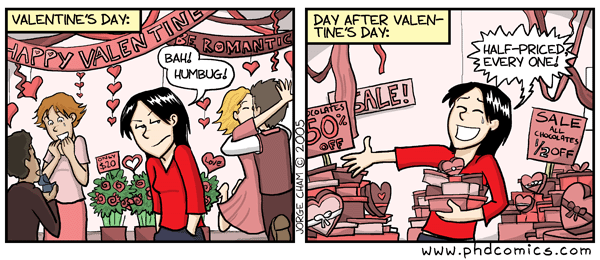
Haha.... No, I'm not really cynical about Valentine's Day, c'mon :D  But I have to laugh at PhD Comics (Piled Higher and Deeper) because of this comic!!!!!! I was sort of bummed on Valentine's Days of years past during the years when I liked specific guys, but I enjoy how Summitview D-Teams still try and do stuff for the singles :) For instance, Symbio singles are taking over Coopersmith's tonight!!! WOOT!!!!!!!!!!!!!!!!!!!!!!!!!!!!!!!! :) But yeah, I do tend to stop and think a bit about my life in the guy-girl relationships arena on Valentine's Day. I think it's only natural since - yeah. I am a girl. However, that doesn't necessarily obligate me to spend a lot of time pondering guy-girlness. Yet the Bible says that married women are helpmates of their husbands. We are equal in worth yet different in our roles. Because of this we long for being a helpmate to someone.


Last night D-Team went to the home of a family from church for dinner. Their four little people were there so of course we played with them for a bit!!! I have to say, Team Ninja guys have decent paternal instincts :) I enjoyed hanging out with the little people too!!!!!!!!!!!!!!!!! They say some pretty great things. What I like about little people is teaching them stuff. Especially since my diagnosis, I've been noticing how I seem to have a more intellectual style in interacting with kids. It's not to say I don't care about them. I just seem to express it differently. However, I can't say that because my interaction style is different, I would be incapable of raising children if God called me to. But one thing I realized is that I saw raising children as a developmental step that I had to somehow achieve to succeed in life.


When I liked certain guys, I would get all twitterpaited when I saw them playing with kids, especially if they had really positive interactions and I could see that the kids were responding well. I would think: "Yay!!!!!!!!!!!!! High paternal emotional availability potential here! Well, this increases my desire to marry said person because our potential children would have really great developmental outcomes because of this and also see God's love a lot more clearly in their father!!!!!!" I would evaluate guys on the basis of how well they would fulfill the role of servant-leader and father in a marriage. Of course, that's not a bad thing at all to evaluate men on, but I think for me, I had a goal:  marriage and I liked guys based on how well they would do in partnering with me in attaining said goal. It was mostly intellectual rather than the feeling of "fluffiness" that seems to happen in guy-girl movies. Sorry, can't think of a more precise word.... ;) 


In an earlier post on this blog, I go a bit more in depth into my thoughts on marriage and how they've changed post-ASD diagnosis. So what goes through my mind when I hang out with kids now or approach days like Valentine's day or other times when the focus is on marriage or guy-girl stuff? I think it comes down to just being in the moment. This comes from releasing myself from the expectation that I should get married to be 'normal.' Shoot! I'M NOT NORMAL, so essentially: who cares :D So I can focus on doing single-people stuff on Valentine's day like our Symbio thing tonight and when I'm around a family, I can just be me around the kids and enjoy teaching them things and hanging out with them. The pressure of wanting things is gone, so the angst of all these things is largely gone too :)

Sunday, February 06, 2011

6 months since my life changed forever: Goodbye to the notion of normal

To continue the series of the 6 months since my life changed forever (and yes, I know it's been more than 6 months exactly), one thing that I realized today is that I had to say goodbye to the notion of normal. There was definitely an intial grief process because it was the loss of my perceived identity as a typical 26 year-old Christian female who was pursuing her career post-masters degree. When I was told that I might possibly have Asperger's Syndrome, I was faced with the prospect of identifing as a member of the individuals with Autism Spectrum Disorders community that I had always viewed from the outside as a student or reseacher looking in. Yes, I had read articles about ASD and knew some of the descriptors sounded eerily familiar, but I had thought, "And here I am, having basically overcame some of these difficulties reading these articles as a future interventionist." Suddenly I was going back over textbooks and articles reading them thinking, "This might be me. I always wondered, but this might be me. These descriptors may be immovable for my life."


My friends told me that there would definitely be positives about pursuing a diagnosis such as receiving services to help me and finally understanding how God had made me. But my mind was reeling when they told me Aspergers Syndrome. I told them, "Imagine if someone told you, 'You might have cancer.' Well, you guys are basically telling me, 'You have cancer. Of your development.'" I wasn't mad at them. I was just scared that there was a sledgehammer about to come down and absolutely shatter all my previous notions of who I thought I was.


Well, figuratively speaking, the hammer did come down. It fell in a bit of a different place than I expeccted with the diagnosis of PPD-NOS. But still, though I knew my identity in Christ was unshaken, my identity of 'a typical girl with a bit of an eye problem' was shattered. My identity as another interventionist in the HDFS field was shattered. I was not a typical post-graduate. I was not a typical person in my field. I didn't know what the future held for me with my new diagnosis. I didn't know how to think about myself. Yes, I knew that God had a purpose for me and that He loved me regardless, I just didn't know where to go from there. That's why I clung so tightly to Dr. Grandin's story in the beginning. I had to see how God directed her life so I could trust Him to direct mine.


After many tears and pondering my life, I am ok with not being normal. No, I don't want God to make the rest of my life a carbon-copy of Dr. Grandin's life :-D I'm NOT THAT CRAZY HAHA!!!!!!!!! But I don't hold the expectations of a 'normal life' over myself and hence get mad at myself when I don't meet them. For instance, I can feel more comfortable in the group-home with the clients than in a staff meeting. Previously, I'd chide myself for that, but now I just say, "Meh, that's how the way God made me." Of course, I've learned some coping strategies and learned how to speak up at staff meetings so I can contribute in a good way.


One major step I took last sweek was making an appointment with the Departmet of Vocational Rehabilitation. Definitely not normal. But I figure, if they can help me learn interview skills and different ways to help me cope at my current and future jobs, than that works for me. I avoided getting disability services for my eyes in undergrad because I had intense shame at admitting any weakness. Anything that would make me stand out from the norm, I avoided.


Yet as God removed the shame of me being different, I felt more free to access these resources. I had to believe that God loves me even in my weakness; that He does not grieve that I am not 'his perfect little child' because I am not apart from Christ. He looks at me - flaws an all - and because He sees Christ in me - He loves me. Not for my abilities or goodness, but because of Christ. As I let go of this notion of trying to be normal, I embraced this truth, and this has made a ton of difference.

Tuesday, January 11, 2011

6 months since my life changed forever: Work and what I want to do when I grow up

First of all: 
OH MY GOODNESS THE BLOG LOOKS DIFFERENT!!!!!!!!!!!!!!!!!!!!!!!!!!!!!!!!!!!!!!!!!!!!!!!!!!!! Just thought I'd say that since I know that's what people will think if they are used to the old format. Well, I added the followers gadget and a search the blog gadget & apparently Blogspot has had updated templates for a while. Well, new year, new DECADE - new blog layout? 


Now onto the intended content: 


I thought I'd go a bit more in depth about how realizing I have an ASD has changed my life in several different areas just because it's nice for me to see and because it just shows how much I had to re-think my identity, but also how having an underlying trust in God in all these areas made this shift so much easier.


I went into HDFS because as a pediatrician, it would be nice to know about child development. I wanted to be a pediatrician so I could eventually work with and treat kids who were adopted that had attachment and/or development and/or sensory integration issues. Contrary to popular belief, I didn't chose HDFS because cute kids automatically made me eeek. In fact, my mom has a picture of me holding my second cousin with this look on my face like, "Oh dear God, help me hold this kid because I don't want to drop her and I'm not used to being around kids!!" 


I had to grow into working well with kids. I had to grow into working well with people too. In retrospect, if I was in Temple Grandin's words, "an anthropologist from Mars" when it came to figuring out people and social situations, studying HDFS made it a bit easier. 


Why do I start out with this? Because I was always bothered by the fact  that the book-learning about development didn't necessarily translate into being able to handle interactions. For example: most people felt at home in the early-childhood classroom at the lab school at CSU and would feel at home in the Summitview nursery when they volunteered. For me, I could talk nicely to the kids and do basic stuff like remembering to get down at eye-level and explain things so they could understand, but I always felt like I was going at it firstly from an intellectual rather than an emotional standpoint. God gets infinite points (well, first because He's GOD) for helping me open my emotions to these kids that He allowed me to help. I think one of the reasons it was hard for me to open my emotions up was because if I felt the attachment a caregiver feels for his or her child, I would begin to miss the attachment I needed to feel growing up. In fact, I felt a sense of sadness when we discussed optimal parent-child interactions in class because I knew it wasn't like that for me growing up. 


Anyway, as I got further into working in HDFS, I realized that a lot of people assume that people with an HDFS degree are naturally good at helping people and don't expect a person who does attachment work to put her foot in her mouth while at her internship. Well, during my summer internship in grad school, I ended up with foot-in-mouth syndrome a few times. Thankfully, God gave me grace & my supervisor understanding :) But still, I think that was a shock to both of us. Even in other things like doing research, I had some difficulties actually interacting with the team. That was always weird to me. Also, I could observe parent-child interactions, but it took me a bit longer to pick up on cues. My advisor always seemed to point out little things I missed, and it took a lot out of me to observe that keenly. 


Finding out I had an ASD made all of that make sense!!!! FINALLY! Yes, I can still teach kids on a limited basis, yes I can still do research, yes I can still work with a team, but it is more challenging than it would be for most people in the HDFS world. They only have to study interactions for research purposes. I have to study interactions all the time just to avoid foot-in-mouth syndrome or other things. Unfortunately, this means that some jobs in my field might not be good for me. I thought about maybe going back and getting a Marriage and Family Therapy degree, but I know that reading client's feelings closely as well as analytically figuring out their problems would be a lot for me. Also, I don't think I could work in a child-care setting 40 hours a week. I enjoy doing Sunday school and babysitting for special-events at Summitview, but there is usually a 1 adult to every 3-5 kids, and in a child-care setting the ratios are much higher. I know I'd get overwhelmed if I had to manage a classroom with a 1:6 or above ratio because that's what the ratio was at the Early Childhood Center, and I was exhausted after a Friday afternoon of being there for my practicum. 


So, what can I do? Well, I've decided to do some volunteer grant-writing to see how that goes. I enjoy research, and recently, I wrote an article for the Examiner, with more to come :) I'm pondering the idea of having a developmental services company that specializes in grant-writing, curriculum development for interventions, and more what I call 'techie' aspects of Human Development and Family Studies work. If things start rolling along smoothly, I might go back and pick up a PhD to gain more research and expertise. Hm... yes, this sounds a bit like what a certain professor did, but different field very different field, folks!!!!!!!!  


This is definitely not what I was expecting to do with my degree, and knowing that I'll be in the human services world, but not in the way people usually are took a lot of shifting in my thinking. I panicked a bit and thought, "Oh no, did I go into the WRONG FIELD!?" No.


If I believe in a God who is sovereign and who opened the doors to me being in HDFS, this is not a mistake. I thought being premed was a mistake when I didn't do so hot on the MCAT, but God came though and provided that job in the hospital that allowed me to use my knowledge. I'm still using some of that knowledge in my current work as a direct care provider at a group home. God taught me about trusting Him for a career in general when I graduated, and it is this groundwork of trust that is helping me trust Him with whatever unique role He has for me in the HDFS field given both my strengths and my limitations.

Friday, January 07, 2011

6 months since my life changed forever - the overview

This is a re-post from my blog on the Wrong Planet forums. I thought it should be on here too. Some of this content is a bit repetitive from my other posts, but it's kind of a summary of my life these past 6 months. 

Yup. June 30, 2010 was when I went into the Psychological Services center at Colorado State University for the evaluation to determine whether I had Aspergers Syndrome or not. In May on Memorial Day, three friends from church - two Human Development and Family Studies (HDFS) graduates like me, and one licensed middle school teacher, sat me down and told me that they had been noticing social quirks and how I still talked about HDFS intensely even though I had graduated a year ago. They suspected that I had Aspergers syndrome, even though I studied parent-child attachment and had accurately observed interactions. Yet, I wondered if they were right because though I could observe interactions, I had trouble in actual social situations with a lot of people or if I was already stressed out. Throughout my life, I had always had special-interests. Even in my classes, when we'd talk about autism spectrum disorders (ASD), I could relate in part when I reflected back on my childhood. However, I thought it was because I had learned how to interact late in life due to being adopted at age two after being in an orphanage and after chronic malnourishment and infections. I thought somehow the environmental factors in my early development were the causes of my childhood issues.


The day before I went into the evaluator's office, I went into the Animal Sciences building. This was the building where Dr. Temple Grandin worked. I stood in the lobby and thought. Sometimes I would go in there to write my thoughts about whether I had an ASD or not. Other times, I would sit on the stone benches in the courtyard because I didn't want to spend too much time in the building in case I did actually run into Dr. Grandin. I wouldn't have known what to say or how to explain why I was there.

I found her work about a week after the "I think you might have Aspergers Syndrome" conversation. The first thing that popped into my head was, "SHE WRITES IN APA STYLE!!!!! HOW COOL IS THAT!?!?!?!!?!?!?!!?!?!?!?!?!?!?!?!?!?!?!?!" Right then, we had a nerdy connection because I wrote my thesis and all my papers in APA. It's required for my field. Anyway, that was comforting, yes, in a nerdy sort of way!!! That started my fixation. I knew after the second day of looking up more of her articles and then sitting outside the Animal Science building writing about her work that this would be a fixation. "Yeah, Katie, face it. You probably do have Aspergers. Wait - she had full-blown (classic) autism! She can do it!!! So can you even if you have this thing!!!" That thought, second to Christ, was my anchor. Her life was my anchor. There, I said it! Even though I'd sit there and cry worried about my future or if I was re-experiencing the pain in my past just thinking about it, knowing she got through life somehow helped me. God used her life to remind me that everyone - no matter their talents and abilities - has a purpose in His plan.

Thinking about my past and going back through my past hurt a lot. Like I said, I was adopted, but my arrival with my medical problems and need for intensive intervention plus a very dismal prognosis (severe brain damage) at my initial evaluation really traumatized my mom. That and other things influenced how I grew up. I had pain in my childhood from that, and I felt I could never reach normal because of my fixations and social awkwardness. I wanted those to go away so Mom could finally have a perfect child, but I didn't know how to make them go away, or how to stop my brain from going into fixations. I would get yelled at eventually when my mother would get sick of me beating a subject to death, and that stopped a fixation only until another took its place. Until then, I didn't want to be me. Once in 11th grade, I wondered what it would be like to suddenly step foot into my life right then: retain all the academic learning and basic biographical information of myself but loose all the emotional pain of myself? What if somehow I could push the reset button in my life-history? I wanted to.

All this crossed my mind when I walked into the CSU evaluator's office. Luckily one of my friends from the trio that talked to me on Memorial Day came with me. I was nervous. Super-nervous. I was about ready to have my brain spilled out on the table (figuratively) for someone else to sort through to see what was wrong with it. Being an HDFS graduate, I knew what she could find. That made it worse. And knowing I had to talk about my past made me hurt even before I said anything.

I made it through the diagnostic interview. I also made it through half a box of kleenex and probably put indentations in the carpet from my evaluator's rocking chair. Yes, I knew it was a stim, but I couldn't help it. YOU'RE PULLING APART MY BRAIN, what do you expect!?!!?!?!?! One highlight of the meeting was that when I told her that I was pretty sure I was fixated on Temple Grandin, she told me that she had met her. I was like, "COOL!!! TELL TELL!" And my evaluator gave me the cliff-notes version of how Dr. Grandin talked to some of the staff just about autism and stuff by giving one of her standard lectures. That kinda made me smile. The suggestion that I should meet Dr. Grandin made me eek (haha, more on THAT later ;) ;) )

I was calmer later when I had to do the actual ADOS. It wasn't as bad as I thought. The evaluator seemed to think the same thing. Then came the two weeks of waiting for the results. That was not so fun. WHAT!?!?! I seriously spilled my BRAIN and now I have to wait two weeks for you to sort through it!?!?! Welcome to the world of psychological evaluation, especially for complicated clients like myself.

So, two weeks came and went. THEN came the results

Congratulations, you have PPD-NOS - Pervasive Developmental Disorder - Not otherwise specified. You have a speech delay which puts you out of the Asperger's camp, but you're not as impaired in some areas as people with classic autism. However, you almost almost almost almost came close to getting a classic autism diagnosis (high functioning). This means you and Dr. Grandin almost almost almost were DIAGNOSIS TWINS!!! (except for being like a billion years apart in age, obviously)

What!?!?!? 
Weird??
Ok!
Cool!
Wait.... what?
Oh ok.... Whelp, that explains a lot!

Where did I go from there? Well, the day AFTER I got my diagnosis results, I went into the Animal Science building again. I was sort of re-creating the 'going through doors as symbols of transitions' thing that Dr. Grandin wrote about. Walking up the steps felt different. I was effectively saying, "Well, I admit it. It's official. I'm like you, Dr. Grandin. I'm on the autism spectrum. Here I am. I've seen your life unfold through your writings and lectures. Now I am trusting God with my life. I know He has a plan for it, because He had a plan for yours." It felt weird. Somewhat foreboding making that physical manifestation of accepting my diagnosis. The door had closed on me ever being 'normal.'

But that was liberating too!! An odd side-effect of this whole diagnosis process was that I didn't stress about getting married. That whole stress of getting married was because I wondered: "When would I be like most girls my age? When will I become a mature Christian woman?" I thought marriage was a developmental milestone to mark those two things. But now, knowing I wasn't normal, I didn't have to strive for developmental milestones. God might have another plan. Dr. Grandin admitted she didn't want to get married because it was emotionally complicated and she knows she can't do emotionally complicated stuff. So she just does AMAZING research instead!!!! Suddenly I realized, "That's not such a bad idea for my life!!!!!!!!!!!" Pressure to get married started to come off from me and that was pretty great :D :D :D It's helped me focus on what God wants me to do NOW to reach people, to grow, to serve in the church, and to reach the next generation (via Sunday school teaching for me). I don't have to wait for a magical diamond ring to do it. I just do it in the unique way God wants me to!

Since I wasn't stressing so much about marriage, I could finally FINALLY seriously bounce around the PhD or not to PhD question. And no, not just because Temple Grandin eventually got a PhD. My HDFS friends had been asking if I would continue doing research even before I graduated. I admit, the whole, "What if I get married, would a PhD be worth it?" was a larger factor than I had thought. So, yeah!!!! I'm thinking about eventually PhD-ing it!!! Just have to get some street cred (work experience) first!!!!! And pay off student loans. And then convince my mom that it's still a good idea for me to go back to school, if that's what I'm supposed to do.

I work in a group-home now, and I think I'm more patient with my clients because I know that they'll never be normal. I keep their behavior goals in mind, but I don't hold them to 'normal people' standards of behavior. They won't ever be normal, so why push it with them? I just help them grow in their areas of behavior that they need growing in, otherwise, we just chill. Sometimes I joke with them like, "Yeah, I'm not normal too, so I know." Learning about my own sensory issues has really helped me support one of my clients who also has sensory issues.

Over these past six months, I've had to look at my past again. During the diagnostic interview, I realized just how much pain my past had caused me. It was tempting just to focus on learning about Temple Grandin's life, but I would make myself stop and line her life up against mine. When something bothered me such as: Why did she get a full-time decently-understanding nanny and I got a traumatized parent?? God would help me think about my past differently. No, I didn't get a full-time nanny, but I had amazing teachers that spent about the same amount of hours with me as Temple's nanny did with her. Realizing this, and realizing that God did get me through the pain helped heal me. Her life was a starting point that God used to really heal me from the pain in my past. This healing isn't done, but when I look at where I was six months ago, it's amazing! I think learning to accept myself the way God made me, and learning to accept my developmental history was huge. Knowing that He did allow for me to have a lot of teachers and outside influences that were very highly adaptive shows His hand in my development. That has been such a great comfort!!

And last but not least, if I hadn't gone to get evaluated for an autism spectrum disorder, I probably would've never attended a lecture by Temple Grandin on September 20 at the CSU University Center for the Arts with a friend of mine who was an equine science major :) :) :) :) :) :) :) :) :) :) :) :) :) :) That's right!!!!!!!!!!!!!!!!!!!!!!!!!!!!!!!!!!!!!!!!! We went together because I was still embarrassed that I had a fixation on Dr. Grandin the way NT people get 'typically' obsessed with celeberties. So, I didn't want to go alone. Each to his own, right ;) The lecture was pretty awesome!! I did a mixture of eeking and crying in a good way when she walked on stage. Everyone was cheering loudly anyway, so it wasn't like that was noticeable, but yeah.

I knew most of the content from reading her articles & some of her books. But it was nice to see everything woven together in about a 50 minute lecture. The professor side of her totally came out when she started the Q & A by saying, "Now it's your turn to ask questions, and if no one comes up, I'll start calling on people." I laughed SO HARD!!!!!!!!!! Then I got to ask her a question!!!!!!!!!!!! I was SO SCARED but EXCITED too :D My dear friend came with me down to the mic and that one malfunctioned two people ahead of me. I thought, "SUPER-DANG!!!" but the tech people were like, "Use the one in front." since we were in the middle of the auditorium. I was thinking What!?!?!?! You mean the one right in front of her lecturn!?!?!?!?!?!?!?!?!?! That's right. That one. I looked at my friend like, "You are SO COMING WITH ME, RIGHT!?!?!?!" My friend totally had my back. Totally!!!! She came with me to the front and gave me a comforting smile before adjusting the microphone down to my little height.

I had to concentrate SO HARD just to make eye-contact and not just read off the paper that I had written my question down which was: "considering the cognitive differences and sensory issues people on the autism spectrum face, how would you help a child on the autism spectrum deal with something traumatic?" I looked up and my brain was like, "AAAAAAAH! I'M ACTUALLY LOOKING AT HER!!!" But I kept my cool :D Her response was, "Well, I broke myself once." Ok, she didn't actually say that, but she told me about a time when she broke a bone but was fine. Then I said, "What about if it's psychological trauma like PTSD?" And she said to remember that it affects each person individually, like several soldiers can see the same things and some could be fine and some wouldn't. I thanked her and went back to my seat with my friend. YE-AH!!!!!!!!!!!!!!!!!!!!!!!!!! I also gave my friend a GIAN HUG after the lecture as a thanks for moral support during the Q & A & just being willing to be very nerdy with me! She told me that the lecture helped her work better with her horse, so both of us benefited :) Let's just say that after the lecture, I was giggly for a week!! No joke!

Other than just eeking about meeting Dr. Grandin, I've began to pray that she knows God better if she doesn't already. Over these past six months, I see how God has helped me walk through life now knowing that I'm on the autism spectrum. He's shown me that He has been there in my past and has a plan for my future. This gives me hope that goes deeper than if I was just learning about the latest interventions. I can connect with God in my unique way because He allowed my brain to be the way it is. This is a big comfort, and I pray that she finds this comfort for her life as well.