Sunday, November 13, 2011

An Outlier in the Single World


At some point recently I stumbled across a ministry called Boundless which is a young adults' ministry run by Focus on the Family. It has articles both for people in the Symbio and Rock demographics.  A lot of the articles are about dating and preparing for marriage. Luckily there are also articles on college and career choices as well. 

When skimming the site, I realized that I'm probably an outlier when it comes to the single world. 
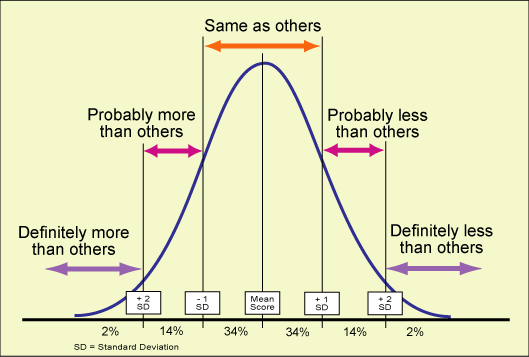
On this graph, I'd probably be in one of the end (light purple arrowed) categories. Boundless and even Symbio are probably geared toward the average and out to 1 standard deviation (within the orange arrows). Average being the average person in their mid 20's - mid 30's. Meaning, probably the average person has 4-5 years of post-secondary education, has had in 3-5 years of Summitview or church ministry involvement, and stands I'd say about a 70% chance of getting married before age 35. 

Going by those statistics, I'd fall within 1 standard deviation. 

But if the statistics were this: Average Symbio female has desired dating or DWAPing for 3-5 years, hopes to marry within 2 years of joining Symbio, and 30% have been in a previous relationship, than I'd be more of an outlier. If the statistics for both male and female were: 90% of the population has frequently prayed for a spouse within the past 6 months, than I'd DEFINITELY be an outlier. 

*Note, these statistics were completely made up without me doing a formal study haha.*

In the Rock I had liked guys and wanted to get married, but that's not my reality now. Over half of articles for single people are about how to deal with life when you really really really want to get married but it hasn't happened yet. I've found one article about a person consciously choosing singleness. It sort of bounced around which was a little difficult, but it was decent. 

I think I've finally settled that for now I've chosen singleness and honestly is really is because I'm on the autism spectrum. It's not because I feel less worthy than my neurotypical peers, but because I honestly don't think I could handle dealing with another person's emotions 24/7. Was seeing Dr. Grandin's path of life right after I got diagnosed a factor? Yup. But it wasn't the only factor. I've been thinking about it a lot. 

So going back to the outlier thing, what am I to do when I realize that ministries like Boundless and to a lesser extent Symbio is geared toward the average population? One thing I remember is God does not treat me as if I'm outside of the statistical norm. He works with everyone individually - those within the average and those on the far sides of the bell curve. And the statistical norm isn't inherently better. It's just what it is. I have to remember that. 

And finally, maybe I can find some other outlying friends, which I actually have. There are other people who are content with being single and aren't planning on getting married any time soon or agonizing over it. We can support each other and see how God wants us to work with and fit in to the rest of our local church family. 

Monday, November 07, 2011

Nerds of Greatness

So today Google had this drawing of Marie Curie on their homepage.
One of my aunts told me about her. I think it was in a conversation about the Nobel Prize.  I had said something about the Nobel prize of medicine. 
Anyway I read up on Marie Curie.  She didn't become a fixation,  but I still thought she was cool. Other scientists I thought were cool were Stephen Hawking,  Ben Carson ( neurosurgeon at Johns Hopkins School of Medicine), and yes Bill Nye the Science Guy. 

Throughout my childhood Helen Keller was still the main famous intellectual I looked up to.

With my current fixation still being Dr. Grandin,  I realized a trend as I looked back: most of my  childhood heroes were not celebrites or athletes. Rather they were nerds of greatness. I guess that makes sense for a girl who slept with science books under her pillow for a while.  


Having nerdy role-models made me feel better about my intense interest in science and medicine related topics. When I got teased at school my list of nerds of greatness made me feel less alone.

Sunday, November 06, 2011

Passing on Musical Memories

In an earlier blog post  I wrote about my connection to music as a child. Today I had yet another cool realization. One of my clients really likes Elvis. 
Technically Elvis is one of his special interests. I'd say it's his main special interest.We as staff motivate him by talking about doing stuff like Elvis. This client named the group home van Elvis. A while back he got a DVD box set of about 10 DVDs on Elvis' life and footage of live concerts and recording sessions. We watched those all day today. 

An older co-worker told me that Elvis covered a lot of old songs because I recognized some of the songs from the radio when I was a kid and Mom would listen to oldies. He covered Simon and Garfunkel's Bridge over Troubled Water and "Sweet Caroline." He was basically a cover-artist who knew how to shake it. 

Those songs brought back memories of listening to old records on Mom's old record player and later on tapes. I remember Mom actually would sing "Sweet Caroline" to me. I guess I really liked it when I first heard it. She may have even sang "Bridge over Troubled Water" to me. Those two songs may have been really soothing. 

As I was cleaning up the breakfast dishes in the kitchen today I found myself singing those songs as they had been played on the Elvis documentary. Suddenly I realized my client was singing along as much as he could. He was on the stairs trying to dance like Elvis while singing. He had a really big grin on his face. 

Suddenly I realized that God was giving me an opportunity to re live my childhood memory of singing the oldies with my mom. It was a neat feeling - I guess what some would call touching - that here I was a grown up in a caregiver role singing these same songs that I enjoyed as a child to another person for his benefit. I think it's cool how God can use stuff like music - sometimes the exact songs I enjoyed to pass on those good memories on. 


Monday, October 17, 2011

A for Autism and awesomeness aka Temple Grandin

So this is a continuation of my previous post :)


When I first was told that I might have autism I freaked out really badly. That was understandable since getting a diagnosis of a disability is hard for anyone. But I truly felt like my future was over and that I would never be successful or achieve anything because I like most other people thought of low-functioning autism when I heard the term.


This picture was taken by the Fort Collins Coloradoan when they covered the celebration where the Temple Grandin Scholarship was unveiled. I was actually at the celebration and ACTUALY GOT TO SHAKE DR. GRANDIN'S HAND!!!!!!!!!!!!!!!! :) :) :) erm... I digress...

That celebration reminded me of how Dr. Grandin changed the way I thought about autism - about my diagnosis of an autism spectrum disorder. I know I've said this a million times on this blog, but it was her story that turned my thinking around from, "AAAH! I'm on the autism spectrum, this means I'll NEVER SUCCEED AT LIFE and I'm somehow lesser." to "Hm... maybe I'll become a famous researcher now that I know I'm way way way more nerdy than the average person." It made me smile a little.

\More importantly, when I think of autism now, I don't think of a child in a corner locked in his or her own world. I think of Dr. Temple Grandin lecturing, or being licked all over her face by cattle, or teaching a class. I think of the way she's honest about her continued need to adapt to sensory issues and how she's continuing to learn about the social world. I think of how far she's come with the right help from teachers, her aunt, and her mother. When I think of autism, I think of her and I think of how I can help my clients engage with the world and adapt just like she has. 


The scary A-Word!

This article here states that infants with low birth weight are at more of an increased risk for autism. The lay-press article is based off of J.A. Pinto-Martin et. al. (2011) Prevalence of Autism Spectrum Disorder in Adolescents Born Weighing <2000 Grams. Pediatrics, 128(5), 882-892. 

It's interesting because I think a lot of people freak out when they read a risk-factor related to autism. It's like the dreaded developmental disorder diagnosis.  Because people often think of kids and adults with the disorder as mute and having severe behavioral issues. They might think about the bad things like uncontrollable temper tantrums that the caregiver can't contain unless he or she figures out the sensory issues or frustration issues behind them. They might think of the things like the child or client not being able to reciprocate affection.

As a caregiver in a group home, I can appreciate how hard it is to deal with the behavioral issues. I have thought many times, "Hm. I wonder what it would be like to get into Client A's head." I can imagine that it would be difficult for someone to raise a child or care for a client long term and have much of that client or child's inner workings of his or her brain be a mystery. I could also understand that the reciprocal affection is not always there. For example, when I say good bye to a certain client, he will sometimes give me a wave, but other times he is off in his own world and will give me a slight glance as I wave to him to leave. On the rare occasion, his wave is paired with a smile. That makes me feel warm inside.

Even if I wasn't on the autism spectrum, I would hope I would have a better outlook when I hear the word autism. I think of when I watched Wizard of Oz with another client for whom tornados and witches are some of his special interests. The big grin he got on his face when I said, "Look, S! It's the tornado! IT'S GETTING THE WITCH!" and he laughed is an image that comes to mind when I hear autism. And the interested look and small smile another client gave me once when I turned on a string of decorative lights in the living room is another good image. Even if I never experienced autism myself, seeing people on the spectrum  enjoying their environments as well as when they struggle in their environment might give me a more balanced picture of autism. If I become an occupational therapist, I hope I can pass that along to others as well.


Monday, October 03, 2011

Feeling Behind no matter What

So today I had a moment of feeling behind in life. I just checked Facebook and found out one of my friends I knew from my time in an internship got married. She's younger than me and she adds to the ranks of other people younger than me getting a ring on it. 
I also hung out with my cousin today who's a teacher and is married with two daughters. Her daughters were really cute. My cousin is 2 years older than me. After we hung out, I went to the CSU campus to work on my Occupationaeltl Therapy school application. 

Suddenly I felt behind. 


Suddenly I felt like I wasn't where I should be in life. I should have a good career going OR I should be married and producing grandchildren for my mom. 

Even though my job at the group home is fulfilling, most people don't see it as a long-term career goal. And I obviously am not married. 


Yet as I entered my coursework into the application, I realized: I accomplished something: A CRAP-LOAD OF SCHOOL!!!!!! But seriously, not everyone gets a chance to go to a university or go to grad school. So those things are accomplishments. And not everyone has the personality needed to work in a group home. 


I thought about it further: What if I had a career? What if I was a program manager instead of a direct support provider at my group home? I could still feel behind if our organization wasn't running our facility like another in the region. I could still feel behind if I didn't have a ring on it. 


OK. Well, what if I had a ring on it and had a kid or so? If I stayed home, I'd feel behind because I wasn't working in the 'real world' even though providing direct care for a child's physical needs and teaching them social skills and helping them accomplish developmentally appropriate tasks is hard hard work. I get a glimpse of it when I work with kids in a classroom and when I see parents out in the field. 


Let's take it 1 step further: Let's say that I had a good career and was a wife and mother. First of all, I'd go insane. Secondly, I could STILL FEEL BEHIND!!!!!!!!!!!!!!!!!!!!!!!!!!! No kidding. I could be like, "This person with the same family structure is moving faster in her career. This person with the same hours as me somehow scheduled in more activities for her kids than my kids have..."


Suddenly a lightbulb came on in my head: We all want to be ahead - to win the big prize of accomplishment.


I think it's just human nature and part of wanting to be a god of sorts.  Yet if I realize that God has a plan for our lives and if we are in Christ, God has our approval because we have Christ's righteousness that He gave to us on the Cross. So we don't have to work for some sort of tangible or intangible trophy. We fall in to the temptation ALL THE TIME. We just have to apply faith and do good in the stuff God calls us to do and tell people about Him. And the cool thing is God helps us with that. 

Then I don't have to bemoan, "Oh, I'm not married. Oh, I don't have an AMAZING career, oh, I'm going back to school while everyone else's lives are moving on.... oh woe is me. :P" I can thank God for where He has taken me, where I am now, and where He would want me in the future :) Then I don't feel behind anymore. I feel right where God wants me :)

Tuesday, September 20, 2011

Seeing another's path and finding my own

I'm taking a class called Handicapped Individuals in Society  (OT 355) as part of preparing to apply to CSU's Occupational Therapy  program. Sometimes it makes me remember or think about how I've dealt with my disabilities in the past and how I'm doing now. 


According to the reading I read yesterday, people who are in the bargaining mindset (from Kubler-Ross's grief process model) see a glimmer of hope and seek out how their disability can be fixed. 


I realized that was partially to account for my fixation on Dr. Temple Grandin. Soon after my diagnosis of PPD-NOS, I was searching for a future. I was wondering, "Now what?" Conveniently enough, someone had lived life with an autism spectrum disorder and she was just a bus-ride to campus away. 


I became fixated on her life because I needed a path to walk down. My whole sense of who I was and my future was rearranged, and I needed somewhere to go. 


I thought, "If my life could look like hers, I will be ok." "If I do what she does, then I think all this will be worth it." That was why it was the bargaining phase of my thinking. That clamoring to find something to not necessarily fix, but finding something good to balance out the really intense bad feelings of, "Oh my goodness, someone threw a sledgehammer at my development / identity / future plans!!!!!!!!!"


Well,  EXACTLY A YEAR AGO, I actually got to see Dr. Grandin at a lecture!!!!!!!!!!!!!!!!!!!!!!!!!!!!!!!!!!!!!!!!!!!!!!!!!!!!!!!!!!!!!!!!!!!!!!!!!!!!!!!!!!!!!!!!!!!!!!!!!!!!!!!!!!!!!!!!!!!!!!!!!!!!!!!!!!!  Yes, she gave that exact lecture, though this picture wasn't taken at Colorado State University. It was pulled from Google Images. Anyhoo... I saw her at the University Center for the Arts at Griffin Concert Hall with one of my best friends Kristina.... IT WAS REALLY AWESOME AND I TOTALLY EEKED AFTERWARD!!!!!!!!!!!!! 

Erm - sorry, I got distracted :) So after the lecture, I realized that I can't follow exactly in her footsteps a) because livestock is not my thing (I'd so get trampled, and cows and horses smell funny) and b) more importantly, our ASD affects us in different ways. Dr. Grandin is totally cool with giving a lecture in front of millions of people since that's apparently what she spends half her life doing. She's less comfortable just hanging out talking with people even though she does it during book signings. I don't know how much she'd like working at the group home where I work. I like it :) 

So I realized this: Our paths initially cross wherein we both are on the autism spectrum, and we are both affiliated with CSU, but we're very different. Part of moving into an acceptance frame of mind was when I realized that I could look at her path to see how God used one person's disability and then trust Him for how He would use mine. One way where Dr. Grandin and I are the same, is that I've had the opportunity to help my clients on the spectrum and empathize with them because I've felt similar frustrations as they have.  Where my path will go, I don't know. It might cross Dr. Grandin's path again, or it may go a completely different way, and that's fine :)